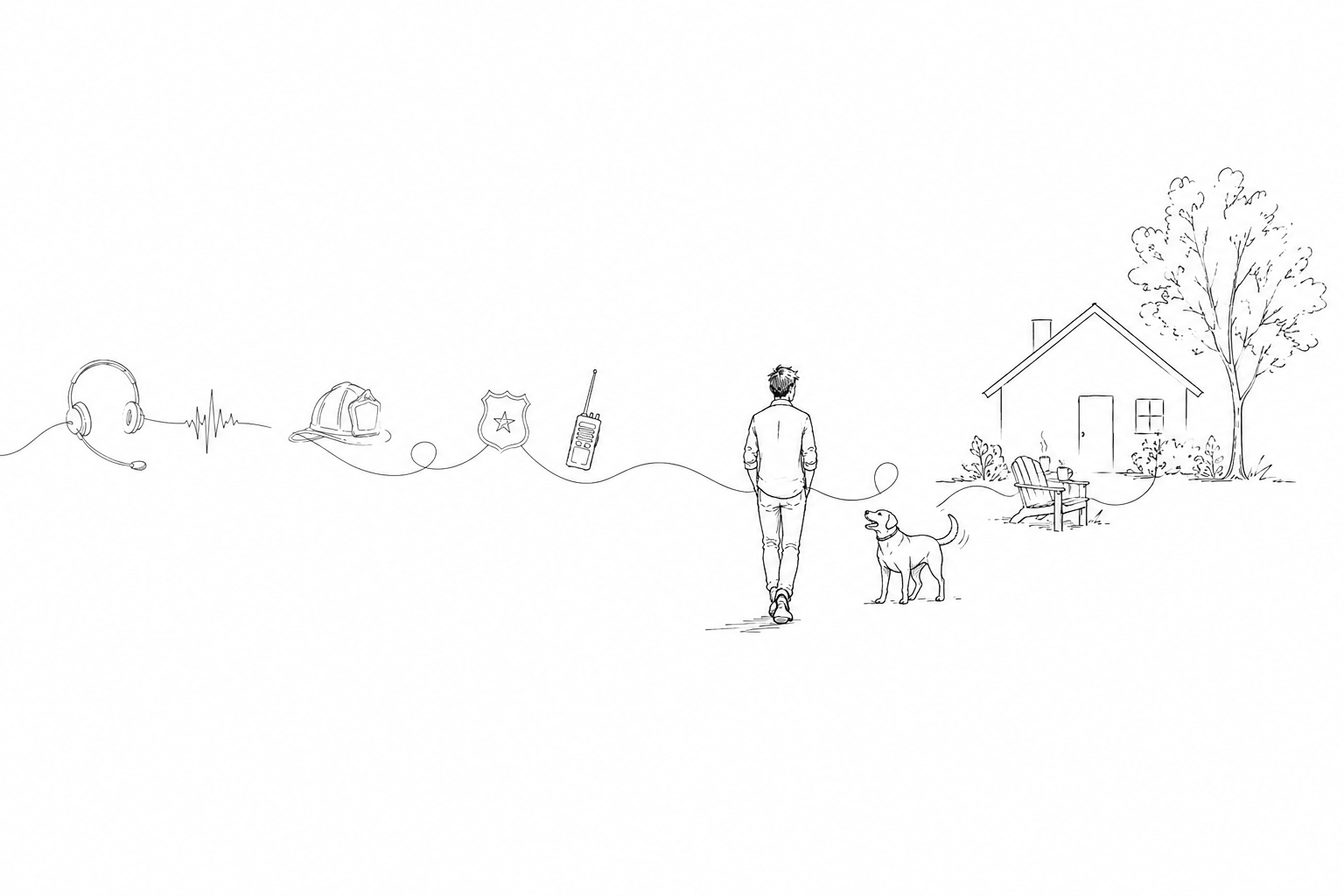
First Responder Therapy in Denton, Tx.
Serving first responders and those who love them.
The job changes things.
You knew the job was going to change you. You can't be exposed day in and day out to what you see, hear, and experience without it having an impact.
Maybe you thought managing that impact would mostly be about work-life balance. You didn't realize how much the training and the job itself would shape the way you operate outside of work.
You're aware of some of the training that spills over into your life outside the job. And then there are other moments when you simply slide into a way of thinking or behaving because it's what you've been trained to do.
You may not even recognize you're doing it.
It's not you. It's the training.
“The training that keeps you safe on the job can negatively spill over at home.”
— Cyndi Doyle, LPC-S, Founder of Pecan Branch Counseling and Code4Couples®
Different jobs. Shared experiences.
Law enforcement, corrections, fire and EMS, dispatch, and 911 professionals each operate in different environments with different cultures, demands, and training.
Some of what wears you down is what you see, hear, and experience. Some of it is the responsibility you carry, the decisions you make, the schedule you keep, staffing shortages, public scrutiny, or the administration you're trying not to lose your mind over.
And while the jobs are different, there are common threads.
You learn to function when other people can't. You respond when something needs to be handled. You make decisions with incomplete information. You adapt to unpredictability. You learn what deserves your attention and what can wait.
Do it long enough and some of those responses become automatic.
That's occupational conditioning.
It can make you very good at your job.
The problem is that your brain doesn't automatically know when those responses are useful and when they aren't.
First Responders
Most first responders who come to therapy aren't falling apart.
They're working. They're functioning. They're getting the job done.
Something in the rest of their life just isn't working the way they want it to.
Maybe you're more irritable than you used to be. You have less patience. You don't see friends as often. You're drinking, eating, gaming, scrolling, working, or doing something else more than you know is good for you.
Maybe you're anxious or depressed. You can't seem to find motivation when you're off. Your relationships feel different. Your kids don't tell you things anymore. You realize you've somehow ended up outside the loop of your own family.
Or maybe someone who loves you has pointed out something you don't really see.
You may come in because of one of those things without recognizing how the career is connected to it.
That's part of the work.
We look underneath the presenting problem to understand what is driving it. Sometimes occupational conditioning is part of the picture. Sometimes it's burnout, cumulative stress, trauma, anxiety, depression, your personal history, or patterns that existed long before the career.
Often, more than one thing is happening.
Being able to function at work doesn't always mean you're functioning the way you want to in the rest of your life.
Women working in first responder careers can face an additional layer of pressure: doing the job in a traditionally male environment while still carrying expectations about family, home, and caregiving. Being capable of carrying all of it doesn't mean you should have to.
First Responder Spouses & Partners
You love them. You worry. You feel resentment.
You want to be supportive. You understand that sometimes the job doesn't give your partner a choice.
But the job's lack of choice often falls on you to figure out.
The call-out comes. The shift runs late. Overtime gets added. Leave gets canceled. A deployment happens with little notice.
They go.
You're the one rearranging work, figuring out the kids, canceling plans, moving appointments, handling the house, explaining another absence, and making everything work.
There is an invisible load that comes with loving a first responder.
And carrying it can get heavy.
You may feel guilty for being angry because you know they didn't choose the call-out. You tell yourself they're exhausted and you shouldn't add one more thing. You keep accommodating because someone has to.
But somewhere underneath all that understanding is a very reasonable question:
When do I matter?
Being supportive doesn't mean you have to absorb everything the career throws at your family.
It's okay to be tired. It's okay to be angry or resentful. It's okay to have limits.
The harder question is how to create those limits when so much really does fall on you, your partner has little left to give, and the job isn't going to suddenly become more predictable.
You shouldn't have to just suck it up and carry it better.
Therapy can help you understand what belongs to you, what doesn't, where you need boundaries, and how to make room for your own needs without feeling like you're failing the person you love.
First Responder Couples
You may both be trying to protect the relationship and still end up hurting each other.
One of you avoids an argument because you've dealt with conflict all day, and home is the last place you want more of it.
The other experiences the silence as: You don't care enough about what I need to talk about this with me.
One of you comes home wanting quiet and space.
The other has been waiting all day to finally have their person back.
One of you thinks, I'm trying to keep the peace.
The other thinks, I don't matter.
Neither interpretation tells the whole story.
Occupational conditioning can quietly change the way couples communicate, manage conflict, connect, make decisions, and respond to each other. Over time, partners develop their own responses to those patterns.
Then you're no longer responding only to what happened today. You're responding to the pattern you've built together.
Understanding that pattern changes the target.
Instead of me versus you, you can begin to see us versus the problem.
Connection is a protective factor. Learning how the career influences your relationship gives you the ability to intentionally protect it.
First Responder Children & Teens
You may already see the career affecting your child. Or you may be wondering if it is.
Maybe they're asking more questions about whether you're safe. They're anxious when you leave for work. They worry when they hear sirens or see something on the news. You're noticing more questions, anxiety, worry, or emotional outbursts.
Sometimes the job enters their world in ways you never intended.
Your child's friends find body-camera footage online at school. A critical incident becomes something classmates talk about. Your child gets teased or bullied because of what you do. They hear opinions about police, firefighters, or first responders that they aren't emotionally prepared to sort through.
They may also be navigating missed events, changing schedules, interrupted plans, or the uncertainty that comes with a parent's job.
Children and teens don't always have the language to tell you what they're carrying. Behavior, anxiety, anger, withdrawal, questions, or changes at school may be how you first know something is going on.
We can help children and teens make sense of what they're experiencing, build skills for managing difficult emotions, and talk about things they may not know how to bring to you.
We understand the job. We also know you're more than the job.
First responder therapy shouldn't begin and end with trauma.
Trauma and PTSD can absolutely be part of the picture, and when they are, our therapists have training in trauma-focused approaches, including EMDR and Accelerated Resolution Therapy (ART).
But the career can affect your life without you having PTSD.
At Pecan Branch Counseling, we understand occupational conditioning, first responder culture, relationships, family dynamics, burnout, cumulative stress, and the ways your own history can interact with the demands of the career.
We work with first responders individually, spouses and partners, couples, children, teens, and families.
We look at what's happening now, what may be underneath it, and how the career fits into the picture so we can help you figure out what actually needs to change.
You don't have to leave the job at the door. We know it's part of the story.